
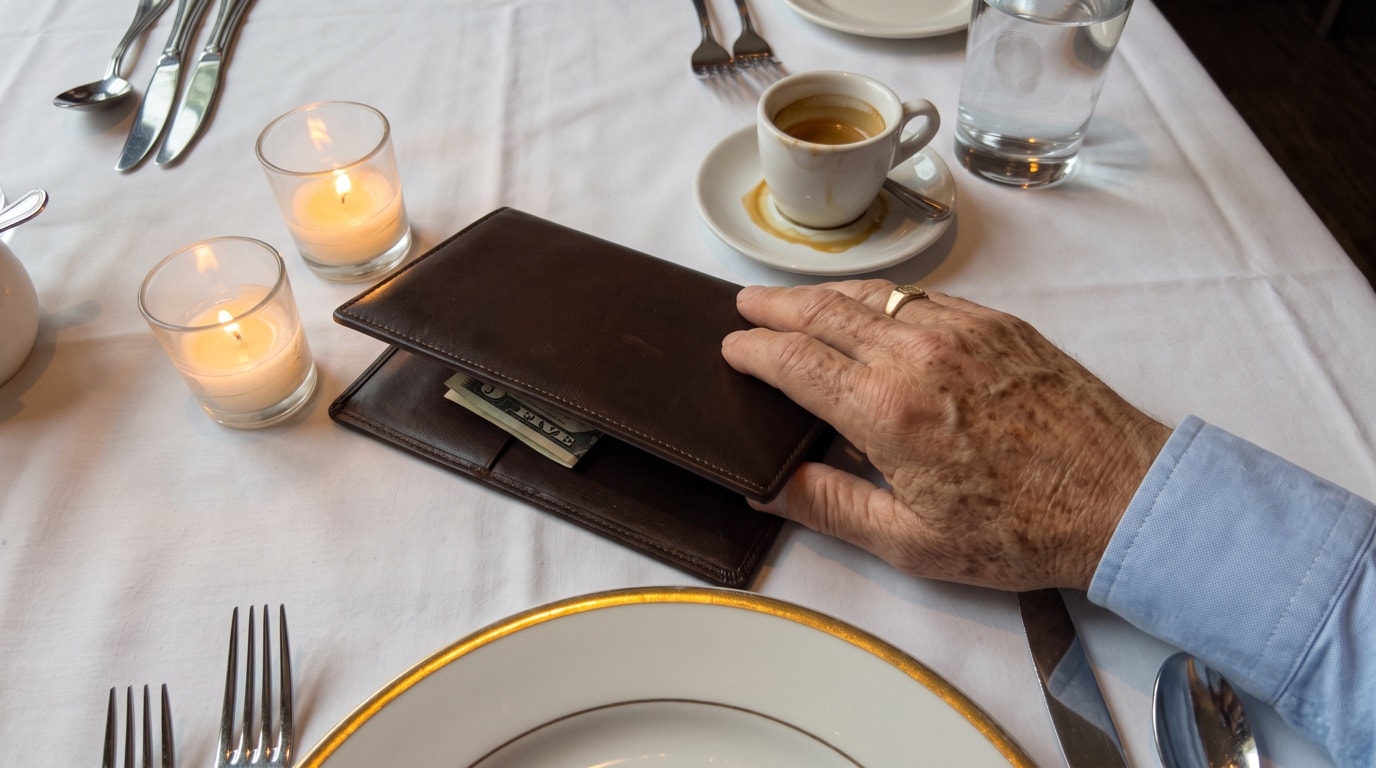
Tipping is the last thirty seconds of the meal and the most honest. The napkin and the forks can be rehearsed; the tip is money moving in real time, and how you move money is the one thing a table cannot help but notice.
The quiet rule: 20% on the pre-tax bill as the floor, decided before you sat down, executed without commentary. No audit of the service out loud, no calculator ceremony, no announcement. This page is the number, the exceptions, and the etiquette around the number — which matters more than the number.
The three rules of quiet tipping
Rule one: the tip is a policy, not a performance review. You decided 20% was your floor before the meal existed. The waiter having an ordinary night does not reopen the question; an exceptional night moves it up. This kills the table-side deliberation — “well, she was slow with the drinks” — which is the single loudest thing a diner can do. Rating labor out loud over the ruins of dessert tells the table exactly how new money feels in your pocket.
Rule two: pre-tax, then round up. The base is the bill before tax — tax is not service. But the discipline is round up, never down: compute the floor, then land on the clean number above it. The person who extracts the pre-tax subtotal to save eighty cents has confessed the eighty cents matter.
Rule three: silence, both directions. No announcing the amount, no leaving it splayed for witnesses, and equally — no narrating a punishment tip. If service failed, one quiet sentence to the manager handles it; a 10% tip handles nothing and travels as a story about you. The tip is a private settlement between you and the person who served.
| Situation | The floor | The quiet note |
|---|---|---|
| Table service, US restaurant | 20% pre-tax | Round up to a clean number; no arithmetic theater |
| Exceptional service, hard table | 25%+ | Delivered without a speech |
| Service charge / auto-gratuity on the bill | Covered | Read the line; small round-up only if something was exceptional |
| Counter service, tip screen watching you | 10% or the round-up, your policy | Decide once, stop re-litigating a $4 coffee |
| Bad service | Still near the floor; manager gets a sentence | The punitive tip punishes your standing more than their wage |
| Bartender | $1–2 a drink or 20% on the tab | Cash early in the night buys a better night |
The screen-flip counter tip deserves one honest note: it is designed to make you decide publicly, under observation, in three seconds. Having a standing policy is how you stay calm in front of it — the discomfort you feel is the design, not a moral question. Set your answer once and give it every time.
Who gets what, beyond the dining room
The restaurant is one venue; the policy travels. These are working US conventions, not laws — set your own version of each once, then stop deciding:
| Who | The working floor | The quiet note |
|---|---|---|
| Delivery driver | 15–20%, $3–5 minimum | Weather and stairs move it up; the app’s pre-set buttons are suggestions, not your policy |
| Barista / counter | $1, or the round-up | One decision, made once — not a fresh moral audit per coffee |
| Bartender | $1–2 a drink, or 20% on the tab | Cash early buys a better night than a flourish at close |
| Hotel housekeeping | $3–5 per night, cash, daily | Left with a note — staff rotate; the last-day lump misses the people who did the work |
| Bellhop / valet | $2–5 a bag; $2–5 at retrieval | Handed at the moment of service, without ceremony |
| Taxi / rideshare | 15–20% | In-app is fine; consistency beats theater |
| Room service | 15–20% — unless the menu shows a service charge already in the bill | Read the ticket first; tipping twice is theater, not generosity |
| Grocery / flower delivery | $5–10, more for stairs or weather | The app fee is not the tip; the driver rarely sees it |
| Hair, barber, spa | 20% | Regulars who tip consistently get the appointments that don’t exist |
| Babysitter | Round up generously; one extra hour for the late return | Plus a real year-end bonus if they’re regular — see below |
| Movers, big services | $20–40 per person per day | Handed to each person, not the crew chief |
| Year-end, regular providers | Cleaner/sitter: about a week’s pay; others: a considered cash envelope | The December envelope is the quiet system’s annual settling of accounts |
The pattern is the restaurant rule wearing different clothes: a floor decided in advance, cash where cash reaches the actual person, and no situation re-litigated at the moment of payment.
The two-dollar lesson
The tipping story that raised me was not about a big tip. A man I knew — the kind whose money you would never guess from what he drove or said — was a regular at an ordinary diner. Same booth, same order, and the tip was always the same: generous, cash, folded under the plate edge, never mentioned in fifteen years. When he died, the waitress came to the funeral. That is the entire etiquette of tipping in one image: consistency, privacy, and the complete absence of an audience. The men who tip for witnesses buy applause that expires at the door. He bought something that showed up at a funeral.
Run the check
Bill, tax, whether service is already on it — the calculator gives you the pre-tax tip and the total, with the rounding rule applied. The output is the floor, not a ceiling:
The quiet tip
The rule in one line: a fixed percentage of the pre-tax number, decided before the check lands, delivered without narration. The tool does the arithmetic so the table never watches you do it.
US convention runs 15–20% pre-tax at sit-down restaurants; the quiet standard is 20 as the floor, cash where it is kind, and no commentary either way.
The part everyone misses
Tipping guides argue percentages as if the number were the etiquette. The number is the smallest part. What the table actually reads is the choreography: whether the tip was decided or deliberated, silent or scored, consistent or moody. A 20% tip delivered with resentment is worse etiquette than 20% delivered invisibly — and both cost the same. This is one scene in the larger dinner exam (the full table test is here), and it hands off directly to the last question of the night: who takes the check.
Questions people actually ask
What percentage should you tip at a restaurant?
Twenty percent of the pre-tax bill is the working floor for table service in the United States; go up for exceptional service or a complicated table, not down for a mediocre mood. If service is genuinely bad, the recourse is a word to the manager — not a punitive 8% that mostly punishes your own standing.
Do you tip on the pre-tax amount or the total?
The rule is pre-tax: tax is the state's line, not the server's work. In practice, on ordinary checks the difference is a dollar or two, and quiet wealth rounds up rather than performing arithmetic at the table. Compute on pre-tax, then round to a clean number.
Should you tip when a service charge is already included?
Read the line: an automatic gratuity or service charge replaces the tip, so you add nothing or a small round-up for something exceptional. If the fee is a 'kitchen fee' or 'operations charge' that does not go to staff — ask, once, quietly — the tip is still owed.
Is it rude to tip too much?
Overtipping is not rude; announced overtipping is. The 50% tip delivered with eye contact and a pause for witnesses converts a kindness into a purchase of status, and everyone at the table feels the transaction. Tip generously and invisibly — the amount is between you and the person who served.