
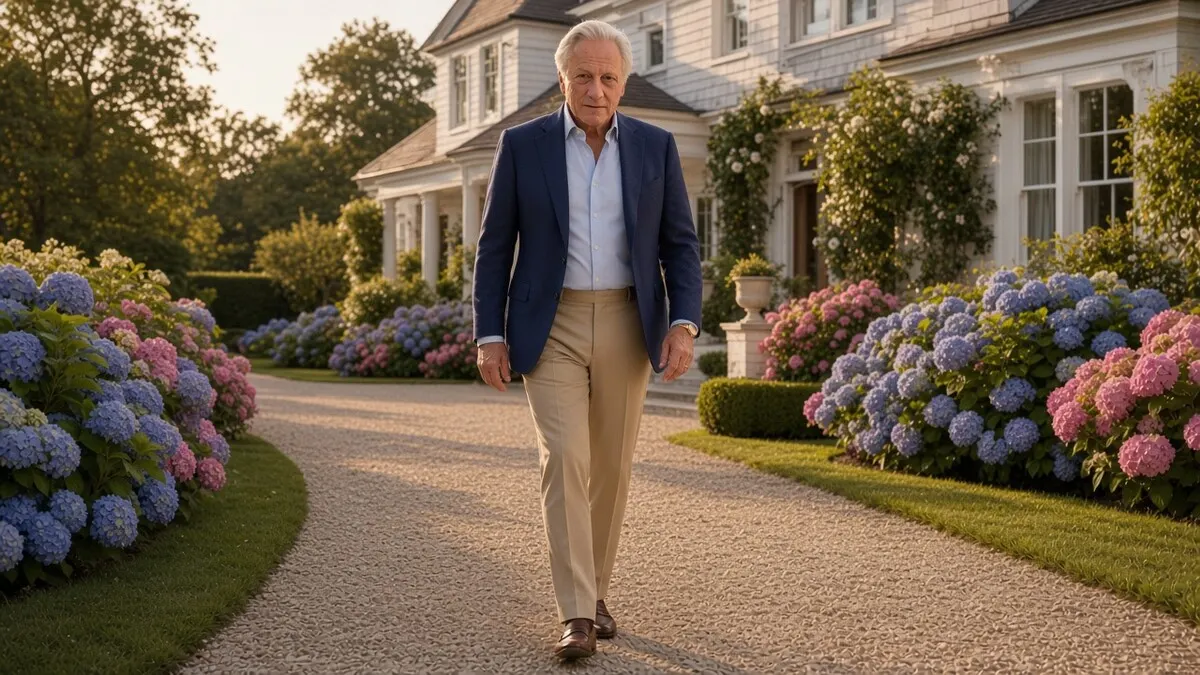
The irony of old money style is that the internet sells it as a shopping list. A look built on not buying things — on wearing the same good coat for a decade — has become a reason to buy a new wardrobe every season. That is the costume. The policy underneath it is cheaper, and it is the part worth copying.
This page covers what the look is, what wealthy people actually spend on clothes, and the five rules that produce it at any income.
What is old money style?
“Old money aesthetic” is the name TikTok and Pinterest gave to a revival of preppy dressing: khakis and oxford shirts, tweed blazers, tennis whites, sailboats, and vintage Ralph Lauren campaigns, as Vox documented when the trend took off.
Stanford law professor Richard Thompson Ford, author of Dress Codes, defines it for GQ as anything that evokes mid-20th-century East Coast elites — classic, not trendy, made to last — the style that, ten or twenty years ago, “we would’ve just called preppy.”
None of it is new. Preppy style traces back to Ivy League campuses, and it resurged in the 1980s with Ralph Lauren and The Official Preppy Handbook, published in 1980.
Every revival repackages the same small set of garments.
That is the first useful fact for a budget: the core pieces have been manufactured in enormous numbers for decades, which means a great many of them are sitting secondhand right now.
What the money actually wears
The fantasy says wealthy people dress in four-figure tailoring. The best-known data on American millionaires says otherwise.
When Thomas Stanley and William Danko surveyed millionaires for The Millionaire Next Door, more than half said they had never spent more than $399 on a suit. In the book’s first chapter, the authors report that the majority had never spent even one-tenth of $5,000 on a watch, and that most were not driving the current model year.
$399
the most that more than half of surveyed millionaires had ever spent on a suitThe same chapter defines wealth in a way that explains the whole aesthetic: not by material possessions, but by appreciable assets. “Many people who display a high-consumption lifestyle,” Stanley and Danko write, “have little or no investments.”
The old money look, read properly, is not a display of wealth. It is the absence of a display, worn by people whose money is somewhere else.
So the honest version of old money style is not a $2,000 cashmere sweater. It is a decent sweater, bought once, kept for years.
The five rules of old money style on a budget
Fit before everything.
A modest blazer that fits through the shoulders beats an expensive one that does not. Shoulders cannot be altered cheaply; sleeves, hems, and waists can.
Buy for the shoulder, then take the piece to a tailor. Alterations are the single best-value line in a clothing budget.
Natural fabric.
Wool, cotton, linen, leather, and silk age into something; most synthetics just age. A secondhand wool coat will outlive three new polyester ones. Where pure fibers are out of reach, a high-wool blend still holds the structure the look depends on.
A narrow palette.
Navy, white, cream, camel, grey, olive, brown. When every piece works with every other piece, fifteen items make dozens of outfits, and nothing ever looks like a fresh purchase — which is the point.
No logos, ever.
Old money style has no billboards on it, which is convenient: unbranded classics are also the cheapest classics.
A visible logo is an advertisement you paid to wear.
Maintenance is the aesthetic.
Resoled shoes, brushed wool, mended knits, pressed shirts. The look that reads as “old money” is mostly cared-for. An inexpensive thrifted tweed jacket, brushed and fitted, looks more convincing than a new one straight off the rack.
For the occasions with rules — black tie, cocktail, country club — the logic is the same and the details are in our guide to dress codes: one notch more formal than required, nothing loud, everything maintained.
| The costume | The policy |
|---|---|
| Buys the “old money capsule” new | Builds it slowly, mostly secondhand |
| Chases the brand the trend names | Ignores brands; checks fit and fiber |
| Replaces items when they show wear | Repairs, resoles, re-hems |
| Many pieces, worn a few times each | Few pieces, worn hundreds of times |
| Spends to look rich | Spends little, so the money can grow |
Where the budget version comes from
- Secondhand first. Consignment shops, charity shops, and resale apps are full of wool coats, tweed jackets, leather belts, and cashmere, because these are exactly the garments that outlast their first owner. Check the shoulders, the lining, and the fabric label; ignore the brand.
- End of season. Outerwear bought new is cheapest when nobody wants it. A coat purchased in March is the same coat in November.
- One in, one out. A small wardrobe stays small only if something leaves each time something arrives. It also forces the useful question before every purchase: what would this replace?
- Build over a year, not a weekend. The look is meant to appear accumulated. Buying it all at once is the most expensive and least convincing way to get it.
Price it in months, not dollars
The arithmetic behind “buy less, keep longer” is cost per wear. As an illustration:
The $300 secondhand wool coat. Worn 60 days a winter for eight winters, it works out to about 63 cents a wear.
The $90 coat. It loses its shape after 40 wears and costs $2.25 a wear — more than three times as much, while looking worse the whole time.
Your numbers will differ; the direction rarely does.
The quiet-wealth version goes one step further and prices visible purchases against what the money would have done in your investments instead. Run any clothing purchase through it:
Loud or quiet: the spend check
Enter the piece you're considering and your liquid capital. The tool prices it in months of your capital's own growth — the real cost behind every 'investment piece' you're being sold.
This purchase costs about 10.3 months of what your capital earns on its own at an assumed 7% a year. You are not buying an item, you are selling 10.3 months of compounding. That is a loud spend at your current pile.
Estimate only. $50,000 at an assumed 7% a year earns about $292 a month before tax. A purchase under one month of growth is flagged quiet. The threshold is a discipline, not a law.
The part everyone misses
Old money style is not a way to look rich. It is what a household looks like when it has stopped spending to be seen. Copy the clothes alone and you have bought a costume — often an expensive one, sold back to you as “timeless.”
Copy the policy — few pieces, good fit, natural fabric, endless repair — and the clothes cost very little, which leaves the rest of the money free to do what the actual old-money families did with it: compound, privately, for a very long time.
If you want the principle in one line, it is the one behind quiet wealth:
Would you still buy it if nobody could see it?
Questions people actually ask
What is old money style?
Old money style is the internet's name for classic, preppy, East Coast dressing: navy blazers, oxford shirts, cable knits, loafers, tailored trousers, muted colors, and no visible logos. The clothes are chosen to last rather than to trend, and they look best slightly worn in — maintained, not new.
Can you dress old money on a budget?
Yes, and the budget version is closer to the real thing than the expensive one. The look depends on fit, natural fabric, a narrow palette, and maintenance — none of which require designer prices. Buy fewer pieces, buy wool and leather secondhand, pay a tailor, and keep everything repaired.
What colors are old money style?
Navy, white, cream, camel, grey, olive, and brown do most of the work, with muted stripes and small checks for texture. The palette is narrow on purpose: when every piece goes with every other piece, a small wardrobe produces many outfits and nothing ever looks like a new purchase.
Is old money style the same as quiet luxury?
They overlap visually but differ in price and intent. Quiet luxury is a retail category of expensive logo-free goods. Old money style is a heritage look built from durable classics, and it can be assembled cheaply. The quiet-wealth version ignores both labels and spends on assets instead of signals.