
Place setting guide: basic, informal and formal
Where every fork, knife, glass and napkin goes, for an everyday table, a dinner party and a formal dinner, in the American and British styles. Each rule is sourced, and every diagram is free to print or embed.
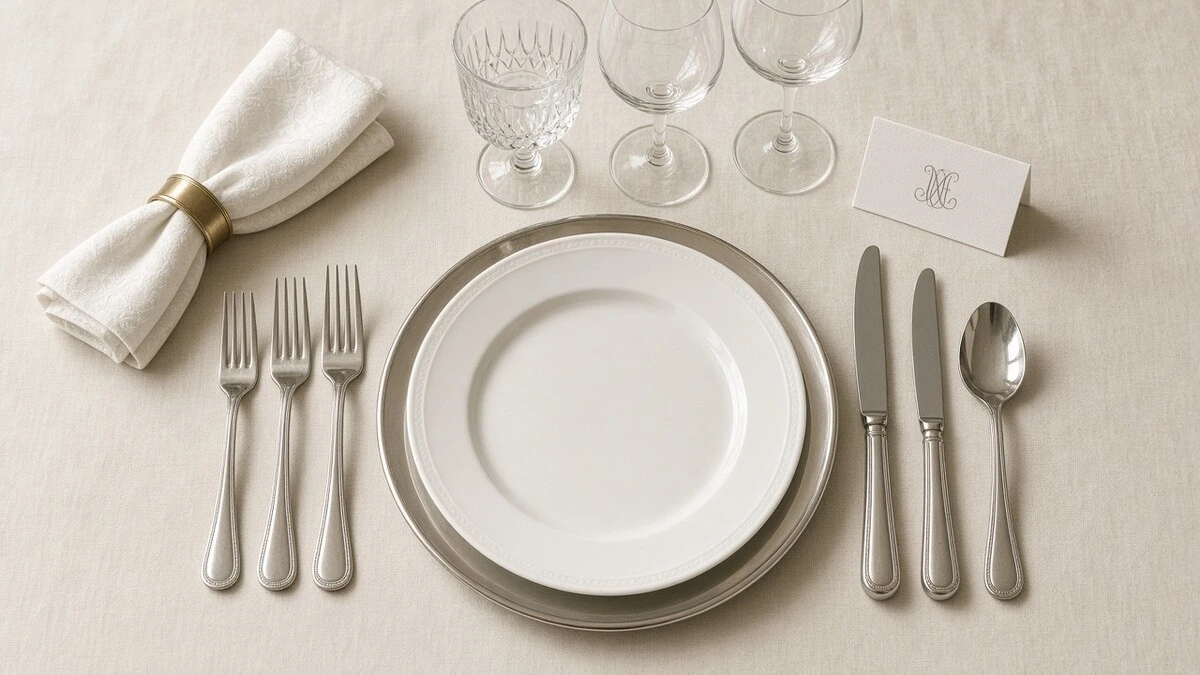
A place setting is the plates, cutlery, glasses and napkin laid for one person at a meal. Lay it correctly and nobody notices. That is the point: asDebrett’s puts it, “the best table manners are always those that no one notices.” The same is true of the table.
The five rules every place setting follows
1. Outside in: the menu sets the order
Cutlery is laid in the order it will be used, starting from the outside. The Emily Post Institute calls the setting “a map of the meal the host has planned”: as each course is cleared with its cutlery, the next course’s pieces are already at hand. Debrett’s says the same of a British table: “The idea is always to work from the outside in.”
2. Forks left, knives and spoons right
Forks go to the left of the plate and knives and spoons to the right. The one exception is the small oyster fork, which is “the only fork placed to the right of the setting.” The layout is designed mainly for right-handed diners.
3. Knife blades face the plate
“Knife blades are always placed with the cutting edge toward the plate.”
4. Bread on the left, drinks on the right
Touch each thumb to its forefinger: the left hand makes a b for bread, the right a d for drinks. Your bread plate is the one on your left and your glasses are the ones on your right.
5. Only what the menu needs, and never more than three of anything
“Not serving soup? Then, no soup spoon for you.” At most three of any implement go on the table, plus an oyster fork; if more than three courses come before dessert, the cutlery for the fourth arrives with the food.
Basic place setting
For breakfast, lunch or a one-course supper. The napkin goes to the left with the fork on it or beside it; the knife goes to the right of the plate, blade in, with a spoon to its right if one is needed. The water glass stands above the knife, or at a 45-degree angle to its right, per the Emily Post Institute.
Basic place setting
- 1. Dinner plate
- 2. Napkin, folded, to the left
- 3. Dinner fork, resting on the napkin
- 4. Dinner knife, blade toward the plate
- 5. Spoon, only if the menu needs one
- 6. Water glass, above the knife
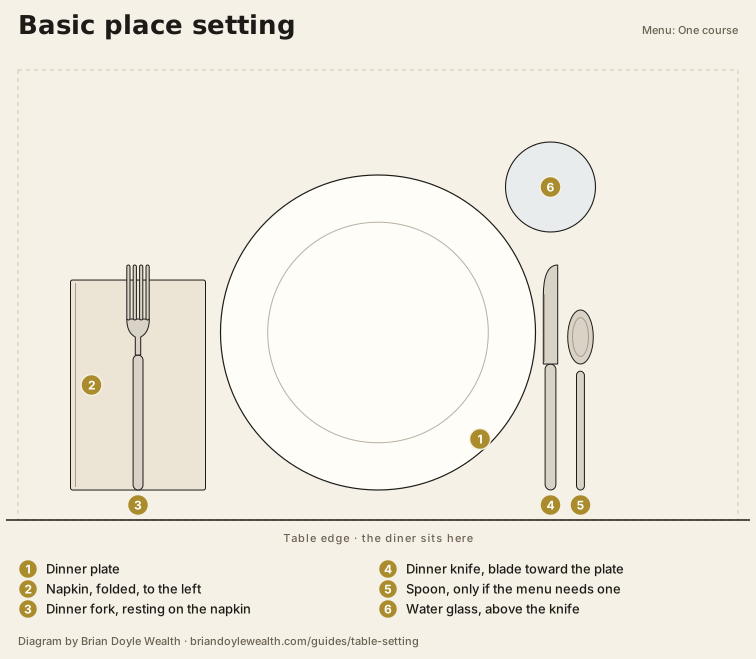
An even simpler version, used by many families and restaurants, lays the fork, knife and spoon together on the napkin to the left of the plate.
Informal place setting
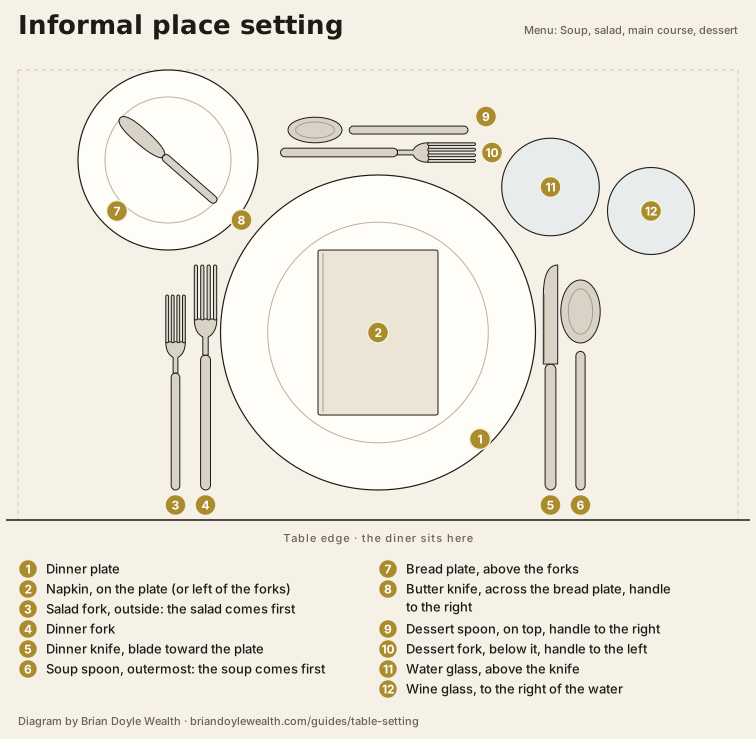
The dinner-party setting, for up to three courses with all the cutlery laid at once. The diagram follows the Emily Post Institute’s own informal menu: soup, a salad, the main course and dessert.
Informal place setting
- 1. Dinner plate
- 2. Napkin, on the plate (or left of the forks)
- 3. Salad fork, outside: the salad comes first
- 4. Dinner fork
- 5. Dinner knife, blade toward the plate
- 6. Soup spoon, outermost: the soup comes first
- 7. Bread plate, above the forks
- 8. Butter knife, across the bread plate, handle to the right
- 9. Dessert spoon, on top, handle to the right
- 10. Dessert fork, below it, handle to the left
- 11. Water glass, above the knife
- 12. Wine glass, to the right of the water
Salad fork inside or outside?
It depends on when the salad comes. Served before the main course, the salad fork goes outside the dinner fork; served after, it goes inside, next to the plate.
Dessert spoon and fork: above the plate or beside it
Above the plate, the spoon lies on top with its handle to the right and the fork below with its handle to the left, so each handle points to the hand that picks it up. Spoon above fork is the traditional order, though the Institute notes it now sees both.
They can also go beside the plate: the fork innermost on the left, the spoon between the dinner knife and the soup spoon.
The rest of an informal table
- The napkin goes on the plate, to the left of the forks, or folded under them. Some hosts dislike the fork on top of the napkin because a guest has to move cutlery to reach it; the Institute calls it a matter of style.
- One dinner knife can serve every course, but a used knife never goes back on the table.
- A separate salad plate goes to the left of the forks, which is worth doing if the main course has gravy.
- One, perhaps two, wine glasses stand to the right of the water glass.
- Coffee cups go above and to the right of the knife and spoons, but at home they usually arrive with the coffee after the meal.
Formal place setting
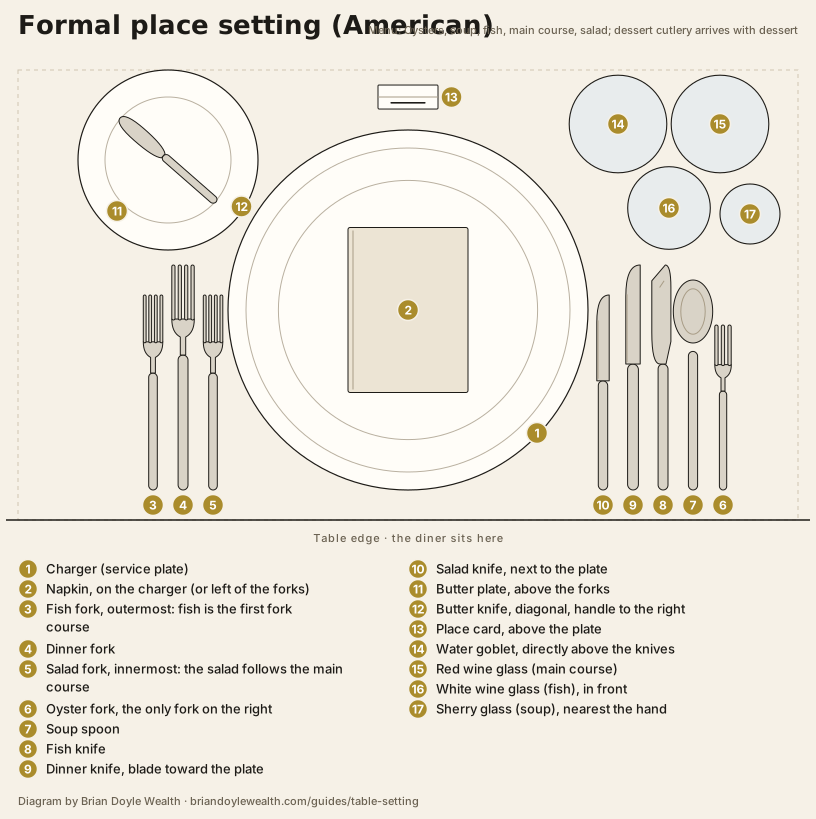
A formal setting is for a meal of more than three courses: the informal setting taken a step further. The diagram uses the Emily Post Institute’s formal menu of shellfish, soup, fish, a main course and a salad after it.
Formal place setting (American)
- 1. Charger (service plate)
- 2. Napkin, on the charger (or left of the forks)
- 3. Fish fork, outermost: fish is the first fork course
- 4. Dinner fork
- 5. Salad fork, innermost: the salad follows the main course
- 6. Oyster fork, the only fork on the right
- 7. Soup spoon
- 8. Fish knife
- 9. Dinner knife, blade toward the plate
- 10. Salad knife, next to the plate
- 11. Butter plate, above the forks
- 12. Butter knife, diagonal, handle to the right
- 13. Place card, above the plate
- 14. Water goblet, directly above the knives
- 15. Red wine glass (main course)
- 16. White wine glass (fish), in front
- 17. Sherry glass (soup), nearest the hand
The charger
The charger, or service plate, sits under the first-course plate and stays for any courses before the main, when it is exchanged for the hot dinner plate.
Forks and knives for the menu
With fish before the main course and salad after it, the forks run fish fork, dinner fork, salad fork from the outside in, and the knives salad knife, dinner knife, fish knife from the plate outward.
If the salad came first and the fish second, the order would be salad fork, fish fork, dinner fork. The soup spoon goes to the right of the knives, and the oyster fork to the right of the spoon.
Glasses
Up to five glasses stand above the knives in the order they will be used. The water goblet goes directly above the knives, the wine glasses to its right, and a sherry glass or champagne flute for the first course or an opening toast further right.
With more than three glasses, the smaller ones go in front, and each glass leaves with its course. The water glass “acts like an anchor” for the whole meal. For which glass is which and how each is held, see our napkin and glassware etiquette reference.
Bread, napkin and dessert
The butter plate goes above the forks with the butter knife laid diagonally across it, handle on the right and blade down.
The napkin goes on the charger, to the left of the forks, or under them only if space is tight. The dessert spoon and fork come in on the dessert plate just before dessert, though the same page notes that a traditional setting lays the spoon above the fork.
Place cards
Place cards go “above the plate on the tablecloth, but some people put them on top of the napkin because they are more easily read.” Emily Post kept them small and plain. Guests should never move them: “The only mistake you can make is trying to switch cards.”
The whole table
“The most formal table is strictly symmetrical”: the centrepiece in the exact centre, an even number of candlesticks, places evenly spaced, and silverware lined up at the same distance from the edge at every place. Keep decorations low enough for guests to see each other across the table.
American vs British place settings
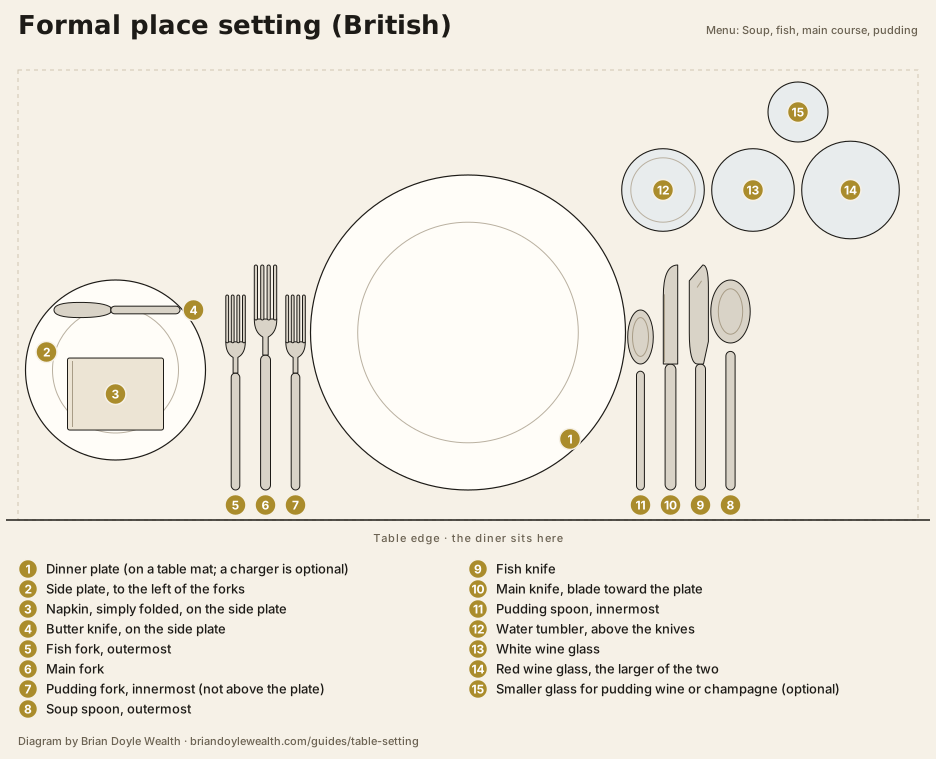
The core rules travel: forks left, knives and spoons right, outside in. The differences are the bread plate, the napkin, the pudding cutlery and the glasses. Here is the formal setting laid the British way for soup, fish, a main course and pudding.
Formal place setting (British)
- 1. Dinner plate (on a table mat; a charger is optional)
- 2. Side plate, to the left of the forks
- 3. Napkin, simply folded, on the side plate
- 4. Butter knife, on the side plate
- 5. Fish fork, outermost
- 6. Main fork
- 7. Pudding fork, innermost (not above the plate)
- 8. Soup spoon, outermost
- 9. Fish knife
- 10. Main knife, blade toward the plate
- 11. Pudding spoon, innermost
- 12. Water tumbler, above the knives
- 13. White wine glass
- 14. Red wine glass, the larger of the two
- 15. Smaller glass for pudding wine or champagne (optional)
| Point | American | British | French |
|---|---|---|---|
| Bread | Bread plate above the forks | Side plate to the left of the forks, laid at every formal place even if unused | Traditionally on the cloth to the left; a bread plate is an accepted English-speaking habit |
| Napkin | On the plate or charger, or left of the forks | Simply folded or rolled, on the side plate | No single rule in our sources |
| Dessert cutlery | Above the plate, or brought in with dessert at a formal dinner | Innermost beside the plate, “not above”; brought in if space is short | No single rule in our sources |
| Fork tines | Up | Up | Down, because family monograms are engraved on the back |
| Glasses | Water goblet above the knives, wines to its right in the order of use | Grouped or in a line above the knives: a water tumbler and two wine glasses, the larger for red | Largest to smallest, left to right |
| From the edge | About 1 inch | Table mat about an inch in | 2 cm |
The side plate
Debrett’s treats side plates as essential at a formal table: “it is correct always to lay side plates – even if they are not going to be used,” with the napkin folded on them.
Bread rolls are eaten “from a side plate to the left of a place setting,” per Debrett’s. In private service, a butler may put the side plate above the main fork instead when space is short.
Pudding cutlery beside the plate
“For formal dinners, pudding spoons and forks should be laid innermost and not above the place setting.” The etiquette coach William Hanson notes that Buckingham Palace now lays pudding cutlery above the plate, the international style, because its guests are largely international.
Where everything goes
- Dinner plate or charger
- Centre of the place, about an inch from the edge
- Which wayBottom rim level with the cutlery
- Forks
- Left, first course outermost
- Which wayTines up (down in France)
- Oyster fork
- Far right, beyond the spoons
- Which wayThe only fork on the right
- Knives
- Right, dinner knife nearest the plate
- Which wayBlade toward the plate
- Spoons
- Right of the knives, soup spoon outermost when soup comes first
- Which wayBowl up
- Bread plate
- Above the forks (US); left of the forks (UK)
- Which wayButter knife across it, handle to the right
- Glasses
- Above the knives, water first, wines to its right
- Which wayIn the order of use
- Dessert spoon and fork
- Above the plate, beside it, or brought in
- Which waySpoon on top, handle right; fork below, handle left
- Napkin
- Left of the forks, or on the plate
- Which waySimply folded
- Cup and saucer
- Right of the spoons, top of the saucer level with the top of the plate
- Which wayHandle at four o’clock
- Place card
- Above the plate, or on the napkin
- Which wayReadable from the chair
- Salt and pepper
- Above the place or between two places
- Which waySalt to the right of the pepper
Measurements and spacing
These are the published figures. The large number is the most common one; where sources differ, all of them are shown beneath it.
- Plate and cutlery from the edge
- About 1 in2 cm in France; 15 mm (“a thumbnail”) in British butler training
- Between pieces of cutlery
- About ½ inAnd ½ inch from the plate (Oregon State 4-H); about 1 inch from the plate (Etiquette Scholar)
- Water glass above the knife tip
- 1–2 inAbout 1 inch (Etiquette Scholar); about 2 inches (Oregon State 4-H)
- Space per guest
- About 24 inCentre to centre; Emily Post’s “about two feet”; 24 to 30 inches (Maryland Extension); at least 20 inches between places (Debrett’s)
- Small plates (salad, dessert)
- About 2 inFrom the edge (Etiquette Scholar)
- Plate sizes
- 10 · 8 · 6 inDinner ten inches or a little more, pudding 8 inches, side plate 6 inches: “a guide, not a rule” (Debrett’s)
- Dessert spoon above the plate
- About 1 inAbove the setting (Oregon State 4-H)
- Place mats from the edge
- 1–2 inEmily Post; about an inch (Debrett’s); flush or within ½ inch (4-H sheets)
- Tablecloth drop
- 12–18 inEmily Post; 16 to 24 inches formal and 10 to 14 informal (Maryland Extension); 8 to 10 inches (Oregon State 4-H)
Set the table from the menu
| If you serve | Add | Where |
|---|---|---|
| Soup first | Soup spoon | Outermost on the right |
| Oysters or shellfish | Oyster fork | Right of the spoons |
| Salad before the main course | Salad fork | Outside the dinner fork |
| Salad after the main course | Salad fork (and salad knife) | Next to the plate |
| A fish course | Fish fork and fish knife | Outside the dinner fork and the dinner knife |
| Steak | Steak knife | In place of the dinner knife |
| Bread and butter | Bread plate and butter knife | Above the forks (US), left of the forks (UK) |
| A main course with gravy, salad alongside | Salad plate | Left of the forks |
| Dessert | Dessert spoon and fork | Above the plate, beside it, or brought in |
| Each wine | Its own glass | Right of the water, in the order of use |
| A fourth fork or knife course | Nothing laid | Its cutlery arrives with the food |
Where the etiquette authorities disagree
The order of the glasses
The Emily Post Institute puts the water above the knives and the wines to its right, the first one poured nearest the hand. Wikipedia lists the water tumbler last, furthest out. British butler training puts red wine to the left of the water and white to its right.
Even the “triangle” differs: Waterford puts white above the knife with water below it to the right, while Etiquette Scholar puts the dessert glass at the top and the water lower left. We follow the Emily Post Institute.
Dessert cutlery
Above the plate with the spoon on top (Emily Post, traditional), brought in on the dessert plate (Emily Post, formal), or innermost beside the plate (Debrett’s).
The napkin under the forks
The Emily Post formal page allows it when space is tight, while the Institute’s Thanksgiving guide says a formal napkin goes “to the left of the forks, not under them.” Oregon State’s 4-H sheet says to put nothing on top of the napkin.
The butter knife
Diagonal across the plate, handle right, blade down (Emily Post), or horizontal across the top with the blade facing the dinner plate (Oregon State 4-H).
A bread plate at dinner at all
In 1922 Emily Post wrote that “butter plates are never put on a dinner table.” Today’s Emily Post Institute sets one, and Debrett’s lays side plates at every formal place.
At the table
A well-laid place tells guests the whole menu before the first course arrives. The rest is behaviour: which fork to pick up, where the napkin goes when you step away, and how to signal that you have finished. Our napkin and glassware etiquette reference covers the mechanics, and our essay on fine dining etiquette covers what the table is really testing.
Questions people ask
What is a place setting?
A place setting is the plates, cutlery, glasses and napkin arranged for one person at a meal. The whole table, with every place setting and the centrepiece, is the table setting.
What are the basic rules of a place setting?
Cutlery is laid in the order it will be used, from the outside in. Forks go on the left; knives and spoons go on the right, with knife blades facing the plate. Set only what the menu needs, and never more than three of any implement, apart from an oyster fork. A course that would need a fourth fork or knife gets its cutlery with the food.
Where does the bread plate go?
In an American setting, above the forks at the upper left, with the butter knife laid across it, handle to the right. In a British setting the side plate goes to the left of the forks, usually with the napkin on it.
Where do the dessert spoon and fork go?
In an American setting they can lie horizontally above the plate, with the spoon on top and its handle to the right, and the fork below with its handle to the left. They can also sit beside the plate, or arrive on the dessert plate, which the Emily Post Institute gives as the formal choice. A British formal table lays them innermost, beside the plate, not above it.
Where does the napkin go?
To the left of the forks, or on the plate or charger. Under the forks is acceptable only when space is tight. In Britain it is simply folded and laid on the side plate.
What order do the glasses go in?
The water goblet stands directly above the knives. Wine glasses go to its right in the order they will be used, with the first one poured nearest your hand; a sherry glass or champagne flute for the first course or a toast goes furthest right. A formal setting has no more than five glasses.
Does the salad fork go inside or outside the dinner fork?
Outside, furthest from the plate, if the salad is served before the main course. Inside, next to the plate, if it is served after.
What is the difference between an informal and a formal place setting?
An informal setting covers a meal of up to three courses, with all the cutlery laid at once. A formal setting is for more than three courses: it usually starts with a charger, can hold up to five glasses, and brings the cutlery for any fourth course, and often dessert, in with the food.
How far from the edge of the table should the plate be?
About one inch, with the bottoms of the cutlery level with the bottom of the plate. That figure comes from U.S. extension and 4-H guidance; French practice uses two centimetres.
How much room does each guest need?
About 24 inches from the centre of one place to the centre of the next. Emily Post called two feet ideal in 1922, and Debrett’s asks for no less than 20 inches between places.
Where does the place card go?
Above the plate on the tablecloth, or on top of the napkin where it is easier to read.