
Table manners: forks, napkins and glassware
The mechanics of a dinner table, settled once: which fork, where the napkin goes, which glass is yours, and how to tell the staff you have finished. American, Continental and British, with the points where the authorities disagree.
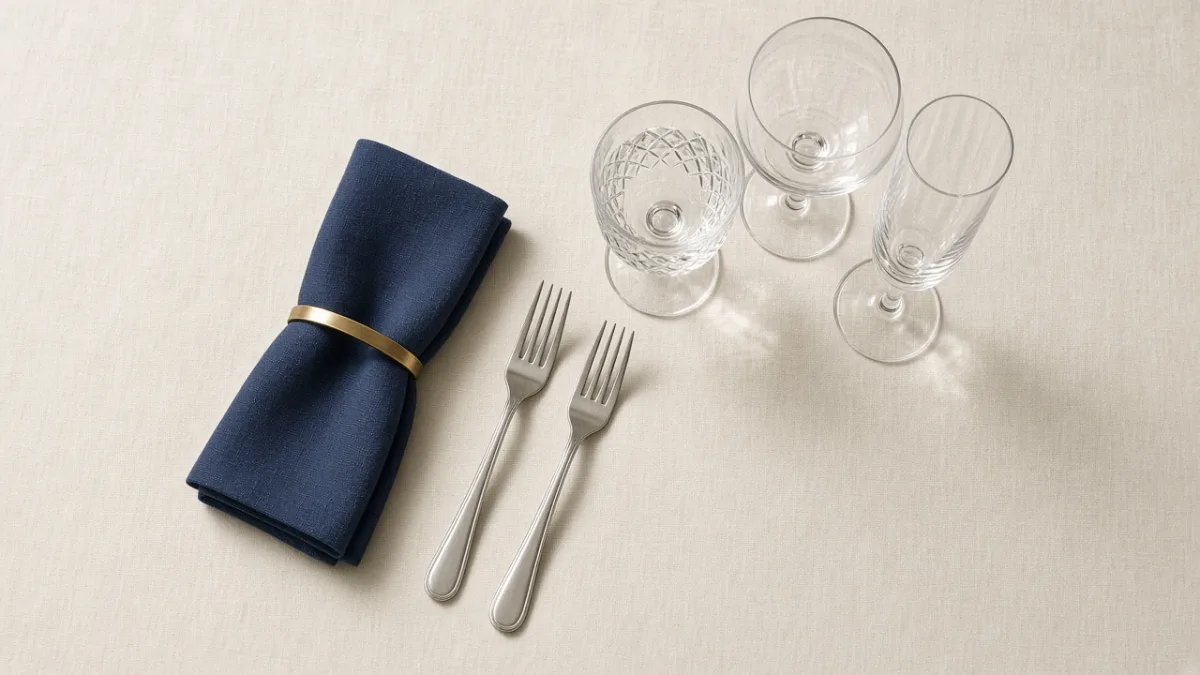
Table manners exist so a meal runs smoothly and nobody at the table is made uncomfortable. They are not a test. Debrett’s is blunt about it: small slips with the “more arcane rules of cutlery-wielding, salt-shaking, bread-buttering, and fingerbowl-dipping will be overlooked because your demeanour is civilised and courteous.” Learn the mechanics once, so they stop costing you attention.
The table manners that matter most
- Phone away. Silenced and off the table. If you are expecting an urgent call, say so at the start and step away to take it.
- Napkin in your lap once you are seated, and use it.
- Sit up, elbows in. Sit close enough that, with your elbows bent, your hands are level with the cutlery.
- Wait to start until everyone has been served, unless the host asks you to begin.
- Mouth closed while chewing, and never talk with it full.
- Keep pace with the table, and cut one piece at a time.
- Ask; don’t reach. Make sure your neighbours have what they need and help yourself last.
- Season at the side. Put salt on the side of your plate rather than over the food.
- Decline simply. “No thank you” covers it; there is no need to say you are full.
Which fork to use
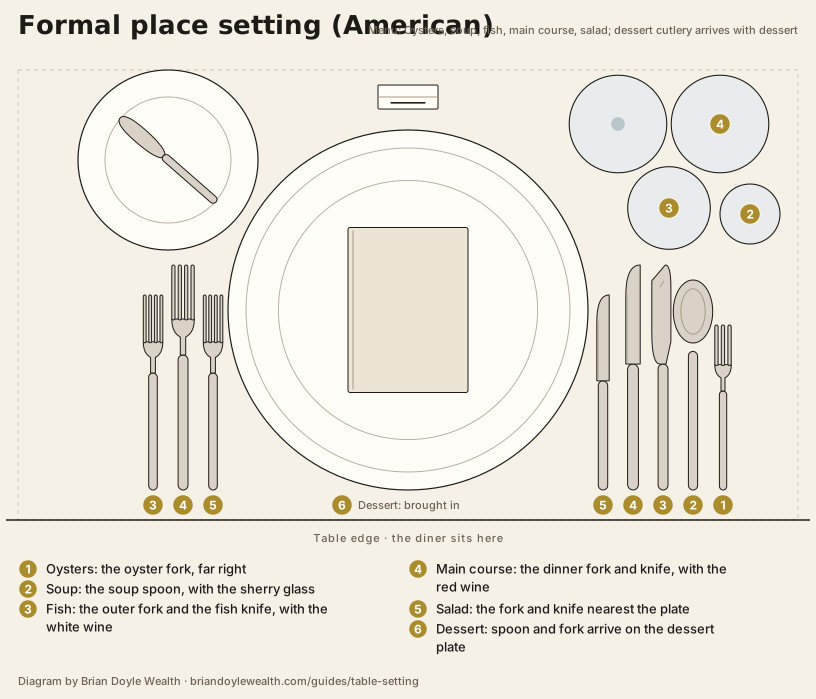
Start with the cutlery furthest from the plate and work inward, one course at a time. The Emily Post Institute describes the setting as “a map of the meal the host has planned”: as each course is cleared with its cutlery, the next course’s pieces are already at hand, and dessert cutlery sits at the top.
Below, the formal setting from our place setting diagram guide is numbered by course.
Which fork, by course
- 1. Oysters: the oyster fork, far right
- 2. Soup: the soup spoon, with the sherry glass
- 3. Fish: the outer fork and the fish knife, with the white wine
- 4. Main course: the dinner fork and knife, with the red wine
- 5. Salad: the fork and knife nearest the plate
- 6. Dessert: spoon and fork arrive on the dessert plate
Telling the forks apart
- Dinner fork: the largest fork, for the main course.
- Salad fork: smaller. It goes outside the dinner fork if the salad comes first and inside if it comes after.
- Fish fork: a small fork, placed outside the dinner fork when fish is the first fork course.
- Oyster fork: the small fork on the far right, and the only fork on that side.
- Dessert fork and spoon: above the plate, the fork’s handle pointing left and the spoon’s right, or brought in with dessert.
Once used, never back on the table
Once you start eating, your cutlery rests on the plate, not the table. At an informal meal one knife may serve every course, but “a dirty knife should never be placed on the table, place mat or tablecloth,” per the Emily Post Institute. Only the fork and spoon go into your mouth; never eat from the knife.
Holding the knife and fork
When cutting, rest each handle in your palm and grip it with your thumb, index and middle fingers near the neck, not in your fist. Debrett’s: “Do not hold your knife like a pen.”
American, Continental and British styles
American (“zigzag”): cut with the knife in your dominant hand and the fork, tines down, in the other. Then lay the knife across the top of the plate, blade toward you, and switch the fork to your dominant hand to eat, tines up.
Continental: the fork stays in the left hand, tines down, and the knife in the right; food goes to the mouth on the back of the fork.
British: when you use a knife and fork together, keep the fork tines down and push food onto it rather than scooping. William Hanson says the tines should never face up in formal British dining while the knife is in use.
Both main styles are correct. Lizzie Post of the Emily Post Institute says to dine in whichever way you handle most comfortably, and to treat adapting abroad as a skill rather than an obligation. A Debrett’s director told CNN that the onus is on the host not to draw attention to a guest’s different style.
Napkin etiquette
Where the napkin goes
Seated
In your lap. A large dinner napkin folded in half, the fold toward your waist; a small one opened fully.
Leaving for a moment: Emily Post
Loosely folded, to the left of the plate, never on the chair.
Leaving for a moment: the chair school
On the seat of your chair, which signals you are coming back.
End of the meal
Loosely beside the plate, usually to the left. Not refolded, not on the plate.
The two middle panels are both taught by established etiquette sources. Emily Post rejects the chair because it can transfer food to the seat or your clothes; the chair school uses it to show you are returning.
When to put it on your lap
The Emily Post Institute says to put it in your lap as soon as you sit down. Etiquette Scholar and others say to wait until the host has taken theirs, except at a buffet. At a private dinner, following the host is never wrong.
How to place and use it
Open it without shaking or snapping it. Open a large dinner napkin halfway; a small one can be opened fully. Never tuck it into a collar, a shirt or a belt. Blot rather than wipe, and blot before you drink. Debrett’s: “dab the corners of your mouth… avoid grand side-to-side wiping gestures.” If the napkin came in a ring, put the ring at the top left of your place.
Leaving the table during the meal: two schools
Emily Post: loosely, to the left
“‘LL’ for ‘Loosely’ to the ‘Left’”: fold it loosely and lay it to the left of your plate, “not on the plate or chair you sit in.” The Institute’s reason is that the chair transfers food to the seat, or worse, to your clothes.
Others: on the chair
Etiquette Scholar: “When leaving the table temporarily, put your napkin on your chair.” Sambonet and business-school etiquette guides teach the same, sometimes the chair’s arm, to signal you are returning.
Debrett’s gives no rule for the mid-meal napkin in the guidance we reviewed. Choose one and do it quietly; nobody will remark on either.
At the end of the meal
Lay it loosely to the left of your plate. Debrett’s: “place your napkin, unfolded, beside your plate.” Keep any marks hidden, and if coffee is served at the table, leave it in your lap until then.
The host signals the end of the meal by putting their napkin on the table; do not refold yours, crumple it or put it on the plate. Never use the napkin to remove food from your mouth or to wipe cutlery.
Glassware reference
Your glasses are on your right. The water goblet stands directly above the knives; the wine glasses go to its right in the order they will be used, a sherry glass or champagne flute for the first course or a toast goes furthest right, and each glass leaves with its course.
A formal place has no more than five glasses, per the Emily Post Institute. The water glass stays all meal. When in doubt, Debrett’s rule is enough: “the bigger, rounder wine glasses are for red, and the taller, thinner ones are for white.”
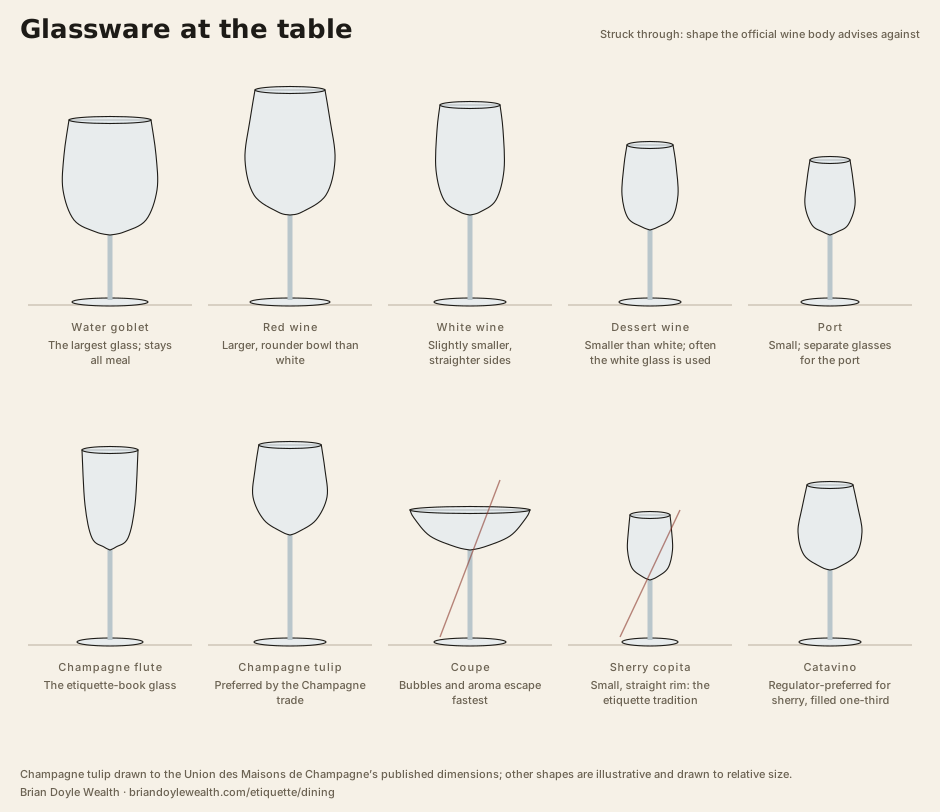
Glassware chart
Water goblet
The largest glass; stays all meal
Red wine
Larger, rounder bowl than white
White wine
Slightly smaller, straighter sides
Dessert wine
Smaller than white; often the white glass is used
Port
Small; separate glasses for the port
Champagne flute
The etiquette-book glass
Champagne tulip
Preferred by the Champagne trade
Coupeadvised against
Bubbles and aroma escape fastest
Sherry copitaadvised against
Small, straight rim: the etiquette tradition
Catavino
Regulator-preferred for sherry, filled one-third
The Champagne tulip is drawn to the dimensions published by the Union des Maisons de Champagne. The other shapes are illustrative and drawn to the relative sizes the sources give. A line through a glass marks a shape the official wine body advises against: the coupe (Comité Champagne) and the small copita (the Sherry Consejo Regulador).
| Glass | Used for |
|---|---|
| Water goblet | Water, all meal. About 6 oz when three-quarters full; directly above the knives. |
| Red wine | Red wine, 3 to 4 oz. Right of the water, in order of use. |
| White wine | White wine, about 3 oz. The first glass poured stands nearest the hand. |
| Champagne | An opening toast, furthest right; beside the water if the only wine. Two-thirds full, “jamais plus”. |
| Sherry | The soup course, furthest right. 2 to 3 oz; the Consejo Regulador says a third of a 200 ml glass. |
| Dessert wine | Dessert, “a few ounces”, often in the white glass. Right of the water, or behind it. |
| Port | Port, in small pours. Separate glasses come with the cheese or the port. |
Etiquette guides vs the wine trade
Champagne: flute or tulip?
Etiquette guides favour the flute, whose long bowl lets the bubbles rise slowly and keeps the wine cool. The Comité Champagne, the trade body for the region, recommends a tall tulip that narrows at the top.
In its view the flute’s narrowness masks the aromas, and the coupe lets bubbles and aromas escape too quickly. It still allows either if you prefer. The Union des Maisons de Champagne calls the tulip “the gold standard” and the coupe “the bane of Champagne.”
Sherry: copita or wine glass?
Etiquette guides give sherry a small copita. The Consejo Regulador, which governs sherry, disagrees: use a traditional large catavino or a good white-wine glass with a generous bowl and a long stem, not “the small glass (the ‘copita’ or ‘Sherry glass’) as it does not allow the wine to fully express itself.”
Holding a glass
Hold a wine glass low on the stem, between your thumb and first two fingers, to keep the wine cool. Champagne tulips are made to be held by the stem for the same reason. The exception is the brandy snifter, which is cradled in the hand to warm it.
Resting and finished positions
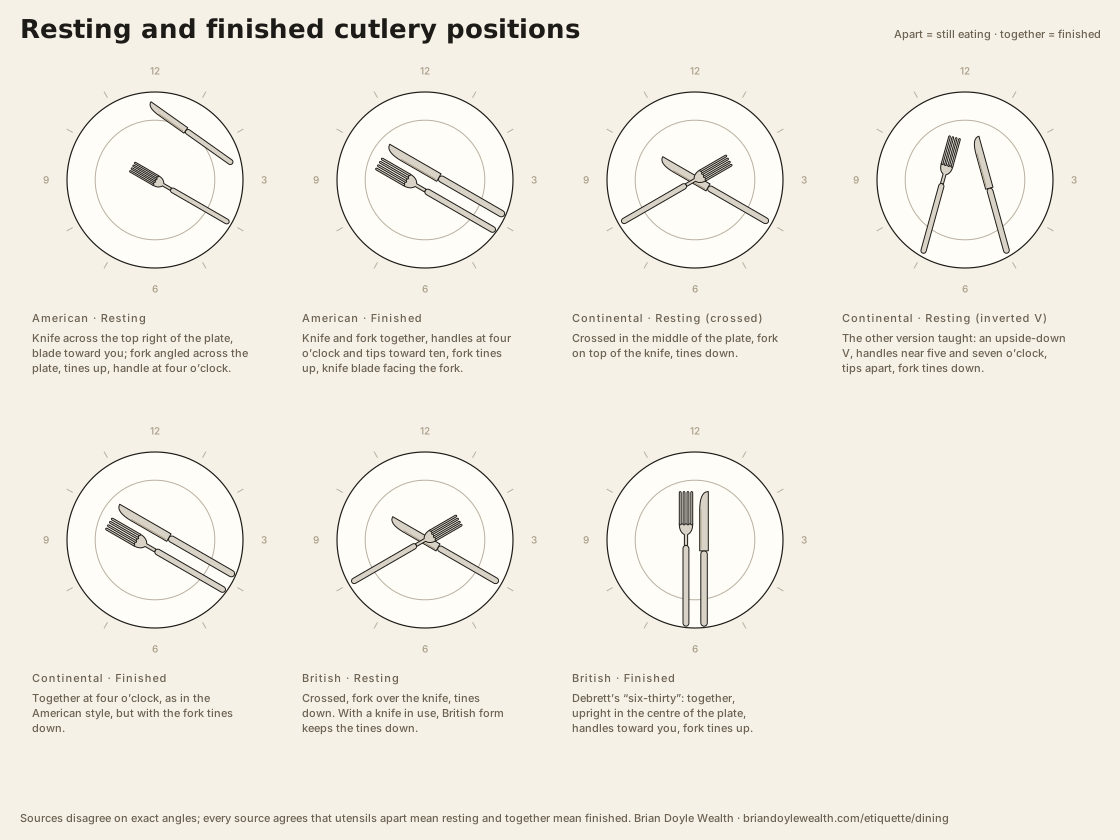
Your knife and fork send only two signals: you are pausing, or you are finished. Picture the plate as a clock face.
Resting and finished positions
American
Restingtines up
Knife across the top right of the plate, blade toward you; fork angled across the plate, tines up, handle at four o’clock.
Finishedtines up
Knife and fork together, handles at four o’clock and tips toward ten, fork tines up, knife blade facing the fork.
Continental
Restingcrossedtines down
Crossed in the middle of the plate, fork on top of the knife, tines down.
Restinginverted Vtines down
The other version taught: an upside-down V, handles near five and seven o’clock, tips apart, fork tines down.
Finishedtines down
Together at four o’clock, as in the American style, but with the fork tines down.
British
Restingtines down
Crossed, fork over the knife, tines down. With a knife in use, British form keeps the tines down.
Finishedtines up
Debrett’s “six-thirty”: together, upright in the centre of the plate, handles toward you, fork tines up.
Sources disagree on the exact angles. Every source agrees on the principle: utensils apart mean you are still eating, utensils together and parallel mean you have finished.
American
Resting: the knife lies across the top right edge of the plate, blade in; the fork, tines up, is angled across the plate with its handle at four o’clock. Finished: “set your utensils on the plate so that both handles are resting on the numeral 4… Pushing it away is not considered polite.” The tips point toward ten.
Continental
Resting: two versions are taught. Etiquette coaches quoted by CNN cross the knife and fork in the middle of the plate, the fork on top with its tines down. Others set them in an upside-down V, handles near five and seven o’clock. Finished: together at the four o’clock position, as in the American style, but with the fork tines down.
British
Finished: Debrett’s gives the “six-thirty position”, with the knife and fork together and the fork “with tines facing upwards”. Sambonet calls six-thirty the English style and 4:20 the French. Resting: crossed, fork over knife, tines down (William Hanson).
The “secret cutlery language” is a myth
Graphics that claim cutlery positions can ask for seconds or criticise the food circulate widely. An etiquette trainer’s verdict: these “utensil signals” simply do not exist. Keep the handles on the plate so nothing slides off when it is cleared. When passing your plate for a second helping, leave the knife and fork on it with the handles well on.
Bread and butter
- Your bread plate is on your left. Emily Post herself sometimes used her neighbour’s; she would apologise and offer hers.
- Break the roll by hand into bite-sized pieces, one for each mouthful, rather than breaking it all up at once.
- Take butter from the butter dish with the butter knife, put it on the edge of your side plate, and butter each piece as you eat it. Hot toast is the exception and can be buttered all at once.
- Do not mop up sauce or the last of the soup with bread.
- When a basket is passed, take one roll; it goes to the right.
- In France, bread traditionally goes on the tablecloth to the left of your place; a bread plate is an accepted English-speaking habit.
Passing at the table
- Food passes to the right, counterclockwise. What matters is that every dish travels the same way. If someone a few places to your left asks for something, pass it straight to them.
- If you start a dish, offer it to the person on your left, serve yourself, then pass it to the right. Pass anything with a handle, such as a gravy boat, handle first.
- Salt and pepper travel together, even if only one was asked for. Taste before you season.
- Use the serving spoon and fork, not your own cutlery; with two serving pieces, use one in each hand.
- Put a heavy or awkward dish down on the table between each pass.
The port goes to the left
Port travels the opposite way. It is “circulated in a decanter, starting with the host, in a clockwise direction around the table. It is correct to pass it on promptly, without putting it down, even if not drinking any.”
By custom the host pours for the guest on his right, then himself, and passes the decanter to the left, and it does not rest on the table until it is back with the host.
Toasts
- At a dinner party the host has the first toast. If the host doesn’t give one, a guest may toast the hosts; among friends a guest often goes first to thank them.
- Toasts come once the drink is poured, usually at the start of the meal or just before dessert. The host’s welcome comes first; other toasts begin at dessert.
- Whoever gives the toast stands, except at a small, informal table, and gets attention by raising a glass, “not by banging on a glass with a utensil.”
- The person being toasted does not stand or drink. They smile, say thank you, and may toast the host in return.
- A sip is enough. Water is fine; you do not need alcohol to join a toast.
Awkward moments
- Something inedible: it comes out the way it went in. If it went in on a fork, it comes out on the fork; if with your fingers, with your fingers. Put it at the side of the plate, never in the napkin. Debrett’s: stones go discreetly into a cupped hand and onto the side of the plate.
- A dropped fork: leave it and quietly ask for another, unless it is a hazard.
- A spill: right the glass, apologise, stem the spill with your napkin and call the server.
- A finger bowl: it arrives on a doily on the dessert plate. Dip your fingertips, one hand at a time, and dry them on the napkin in your lap. Then lift the bowl and doily together to the upper left, and move the dessert fork to the left of the plate and the spoon to the right. In Emily Post’s words: “On no account put anything eatable on top of a lace doily.” Her 1922 rule for the bowl itself: less than half filled with cold water, and a slice of lemon belongs only in a chop-house.
- Place cards: sit where you have been put. Switching cards is “the only mistake you can make.”
Where the authorities disagree
| Question | One view | The other |
|---|---|---|
| Napkin when you step away | Loosely left of the plate, not the chair (Emily Post) | On the chair (Etiquette Scholar, Sambonet) |
| When the napkin goes on your lap | As soon as you sit (Emily Post) | After the host takes theirs (Etiquette Scholar) |
| Continental resting position | Crossed, fork over knife (Hanson, Whitmore) | Upside-down V (Wilson Protocol, Candace Smith) |
| Finished position | Handles at four o’clock (Emily Post) | Six-thirty, tines up (Debrett’s) |
| Elbows on the table | Fine between courses (Emily Post) | Never (Debrett’s) |
| Champagne glass | Flute (etiquette guides) | Tulip (Comité Champagne) |
| Sherry glass | Small copita (etiquette guides) | Catavino or white-wine glass (Consejo Regulador) |
| Clinking glasses | Avoid it, especially with more than four people (Reuters column) | Follow the table; clink with your neighbours (Etiquette School of New York) |
| Which side the server uses | Plated food, drinks and clearing all from the right (Nicolet College) | Serve from the left, clear from the right (KaTom); food from the left in British private service |
For guests, the last row has a simple answer: sit naturally and lean neither way.
For where each piece goes before the meal starts, see the place setting diagram guide, with basic, informal and formal settings in the American and British styles.
Questions people ask
What are the most important table manners?
Put your napkin in your lap, keep your phone away, wait until everyone has been served, chew with your mouth closed, keep pace with the table, and ask for things to be passed rather than reaching for them.
Which fork do I use first?
The one furthest from the plate. Work inward one course at a time. The small fork on the far right is for oysters, and dessert cutlery either lies above the plate or arrives with dessert.
Where does my napkin go if I leave the table during the meal?
Authorities disagree. The Emily Post Institute says loosely to the left of your plate, and not on the chair, so food is not transferred to the seat or your clothes. Etiquette Scholar and many trainers say on your chair, to show you are coming back. Either is defensible; do it without fuss.
Where does the napkin go at the end of the meal?
Loosely beside the plate, usually to the left. Do not refold it, crumple it or put it on the plate. Debrett’s says to leave it unfolded beside your plate.
How do I show I have finished eating?
Lay the knife and fork side by side on the plate. In the American style the handles rest at about four o’clock, per the Emily Post Institute; in Britain, Debrett’s gives the six-thirty position with the fork tines up. Leave the plate where it is; pushing it away is not polite.
What is the resting position?
The knife and fork are apart on the plate. In the American style the knife rests across the top of the plate and the fork is angled across it, handle at four o’clock. In the Continental style they are crossed in the middle with the fork tines down, or set in an upside-down V; both versions are taught.
American or Continental: which style is correct?
Both. Lizzie Post of the Emily Post Institute says to dine in the style you handle most comfortably, and to see adapting abroad as a courtesy rather than an obligation.
Is it rude to put your elbows on the table?
While you are eating, yes. The Emily Post Institute says resting them on the table between courses or after the meal is fine. Debrett’s says not to put them on the table at all.
Which glass is for water and which is for wine?
The water goblet is the largest glass and stands directly above your knives. Wine glasses stand to its right; the bigger, rounder one is for red and the narrower one for white.
How do you hold a wine glass?
By the stem, low down, between the thumb and the first two fingers, so that your hand does not warm the wine.
Which way do you pass food?
To the right, which is counterclockwise, with every dish travelling in the same direction. Salt and pepper go together, even if only one was asked for. Port, by contrast, travels to the left.
How do you eat a bread roll?
Break off one bite-sized piece at a time over your side plate, butter that piece from the butter already on your plate, and eat it. Do not cut the roll or butter it whole.
Should you clink glasses during a toast?
It is optional. Some etiquette writers advise against it at larger tables; others say to clink gently with your neighbours if everyone else does. Never tap a glass with cutlery to get attention.
Do you drink when you are being toasted?
No. Stay seated, smile, say thank you, and, if you like, raise your own glass to the host in return.