Dark jeans
Depends on the levelFine at informal smart casual, and in a smart-casual office according to Reed, if clean, dark and undistressed. Not at formal smart casual, where Debrett’s specifies chinos, "not jeans".[2][5]
The most common dress code is also the hardest to read. Here is how the etiquette books and the style press define it, item by item.
The Cambridge Dictionary defines smart casual as clothing that is “neat and stylish, but not too formal”.[1] Debrett’s calls it “by far the most common of all dress codes”, and also “the hardest dress code to interpret”.[2][3]
The difficulty is that the same two words describe a Friday at the office and a summer lunch in the country. This guide separates them. For every other code, see the dress code chart.
Debrett’s splits the code in two, and the split explains most of the conflicting advice you will read. At the formal end, a jacket is expected and jeans are not; at the informal end, clean dark jeans are fine.[2]
Smart casual began as a description of a lounge suit in a less conventional colour and lighter cloth. The phrase is first recorded in an Iowa newspaper in 1924.
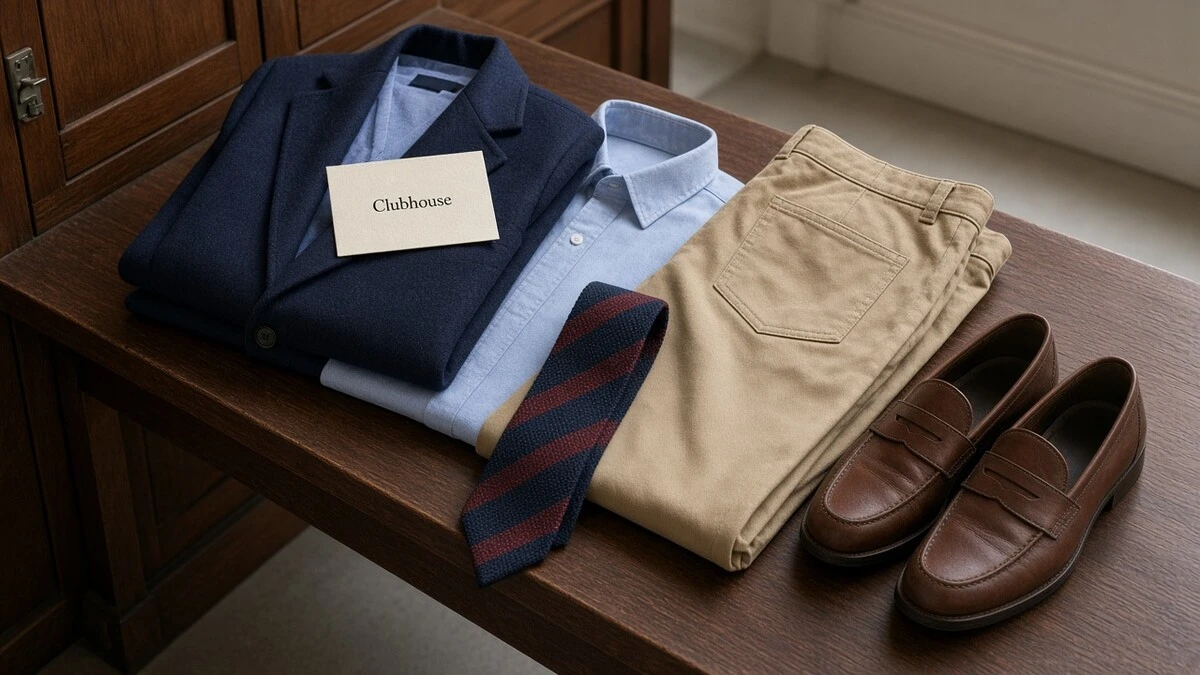
A jacket or blazer; flannels, needlecord trousers or chinos (not jeans); a shirt with a collar, not a T-shirt; smart shoes, “not necessarily lace-ups, but not trainers or sandals.” A sweater if it is cold. A tweed sports jacket with cords or cavalry twill also qualifies.[2]
“Smart, clean, dark-coloured jeans”; polo shirts rather than collarless T-shirts; trousers rather than shorts except in high summer or on the beach. Above all, change out of what you were wearing at home: “Just because an event is informal it is not synonymous with making no effort.”[2]
British GQ defines the smart half as tailoring and leather shoes, and the casual half as clothes designed for sport or leisure, such as jeans, T-shirts and sneakers; smart casual blends the two.[6]
GQ South Africa offers three rules: fit matters more than fabric, muted navy, black and brown look smarter, and allow yourself only one sportswear item per outfit. Esquire UK warns that a shirt, tie, blazer and jeans is one of the biggest pitfalls.
A smart day dress with a jacket is “a safe choice”. At more casual events, smart trousers or a skirt with a cardigan. Avoid denim unless it is immaculate and balanced with a tailored jacket; avoid high heels and suits, which “look like business clothes”.[2]
Dress for the occasion, the time of day and the season. Too much tailoring and heels can look wrong here. Be ready to adjust: swap heels for flats, remove a jacket, take off dressy jewellery.[2] For daytime parties, Debrett’s allows tailored, well-fitted jeans with a tailored jacket, and kitten heels, flats or loafers. For evening parties, dress up: a cocktail-style dress, evening trousers, statement jewellery.[3]
Vogue suggests starting from work staples (blazers, dress trousers, shirts, skirts) and dressing them down, for example a blazer with jeans. M&S calls it a high-low mix: a pencil skirt or wide-leg trousers with a white T-shirt. Who What Wear’s stylist advises avoiding plunging necklines and very short skirts.
Where the sources disagree, the verdict says so. Each verdict summarises the sources cited on its card.
Fine at informal smart casual, and in a smart-casual office according to Reed, if clean, dark and undistressed. Not at formal smart casual, where Debrett’s specifies chinos, "not jeans".[2][5]
Cosmopolitan allows light washes; British GQ and Reed say dark only. Distressed denim is out everywhere.[6]
"Other than in high summer or on the beach, trousers are better than shorts."[2]
Better than a collarless T-shirt. GQ South Africa counts it as your one sporty item in the outfit.[2]
Fashion press accepts a white T-shirt under a blazer. Debrett’s formal smart casual asks for a shirt with a collar, "not a t-shirt".[2]
British GQ and M&S accept clean, minimal trainers. Debrett’s says "not trainers or sandals", and The Ritz London bars trainers from its restaurants and bars.[2][6]
"Ties are not necessary but carrying one is often a good tip, just in case."[2]
The anchor piece of formal smart casual; a tweed sports jacket can take the place of a blazer.[2]
Debrett’s tells women to avoid suits at smart casual because "they look like business clothes". GQ South Africa: a suit worn with a T-shirt "becomes smart-casual".[2]
Debrett’s calls sports clothes and trainers "incorrect" at formal smart casual; The Ritz bars sportswear in all its restaurants and bars.[2][5]
Most of what you will read about smart casual is written for the office. Careers sites stress that the code has no single meaning: check the written policy, ask a manager, and watch what colleagues wear. Reed’s list for the office is blazers, shirts or blouses, chinos, tailored trousers or dark jeans, and loafers, brogues or ankle boots.
On a social invitation, the context does more work: who is hosting, where, and how the invitation arrived (see the two levels). Debrett’s advice when you cannot tell: ask what others are wearing, or ask the host. “It is always more polite to the host to dress up.”[2]
Which is more formal? The sources do not agree. Forbes calls business casual “a bit more formal, conservative, and more restrained”; SEEK says it is “often a step more formal, but neither term has one universal definition”; Who What Wear and Cosmopolitan also place smart casual slightly lower.
Wikipedia notes the two became “virtually undistinguishable” from the 1950s and that any distinction is disputed. Emily Post’s business casual makes the sports coat optional, while Debrett’s formal smart casual expects a jacket.[2][4]
Our reading: in an American office, business casual is usually the slightly dressier of the two. On a British social invitation, smart casual often means a jacket. Read the context, not the label.
Smart casual is also not semi-formal (which asks men for a dark suit and tie) or cocktail (between business casual and black tie).[4] See our guide to cocktail attire for the step up.
Private clubs use a close cousin of smart casual, usually with stricter rules on collars and denim. See our country club dress code guide.
Smart casual rewards fit and upkeep more than spending: GQ South Africa’s first rule is that well-cut clothes matter more than the fabric. Our guide to old money style on a budget covers building that wardrobe.
Clothing that is neat and stylish but not too formal: tailored pieces mixed with casual ones. For men, typically a jacket or blazer with chinos and a collared shirt; for women, a day dress with a jacket or smart trousers with a knit.[1][2][6]
A jacket or blazer, chinos, flannels or cords, a shirt with a collar, and smart shoes such as loafers. A tie is optional, but carrying one is a good idea. At the informal end, clean dark jeans and a polo can pass.[2]
A smart day dress with a jacket is the safe choice. At more casual events, smart trousers or a skirt with a cardigan. Avoid business suits and high heels, and wear denim only if it is immaculate and balanced with a tailored jacket.[2]
Clean, dark, undistressed jeans are acceptable at informal smart casual events and in many workplaces. At the formal end of the code, wear chinos or tailored trousers instead.[2]
Generally not. Debrett’s says trousers are better than shorts other than in high summer or on the beach.[2]
Yes. Debrett’s prefers a polo shirt to a collarless T-shirt.[2]
There is no universal answer. Forbes, SEEK and Who What Wear describe business casual as slightly more formal; Wikipedia notes that the distinction, if any, is disputed. On a British social invitation, smart casual often means a jacket.[2]
No. Semi-formal asks men for a dark suit and tie, and cocktail sits between business casual and black tie. Smart casual is a step below both.[4]
It is disputed. British GQ and M&S accept clean, minimal trainers; Debrett’s and The Ritz London do not.[2][6]
At The Ritz London, for example, smart casual (including smart jeans) is acceptable in the bars and at breakfast, while gentlemen need a jacket and tie for afternoon tea and the restaurant at lunch and dinner. Sportswear is not allowed in any of its restaurants or bars.[5]
Last verified